Caterpillar D10T2: Evolution of a Heavy-Duty Dozing Legend
Introduction: The D10 Legacy
The Caterpillar D10 series represents one of the most significant innovations in heavy construction equipment history. Since its introduction in 1977, the D10 line has continuously evolved to meet the demanding needs of mining and construction operations worldwide. The D10T2, introduced in 2016, stands as the latest evolution of this legendary machine, incorporating advanced technology while maintaining the durability and power that made the original D10 revolutionary.
The Original D10: A Revolutionary Beginning
The original Caterpillar D10 was manufactured between 1977 and 1987. According to Caterpillar's historical records, when the D10 was introduced in 1977, it was the most powerful track-type tractor ever built at 700 horsepower. The machine was revolutionary because it was the first modern tractor to use the elevated drive sprocket, a design feature that would become a hallmark of Caterpillar's large dozers.
The development process for the original D10 was extensive. The first pilot machine, designated D10X1, was shown in July 1973 at a Caterpillar corporate meeting. Prototypes followed in 1975 and 1977, and in March 1977, prototypes P-1 through P-10 were dispatched to different job sites for real-world testing. Between 1978 and 1986, nearly 1,000 D10s were manufactured at Caterpillar's East Peoria, Illinois plant.
Original D10 Specifications
The original D10 was powered by a Caterpillar D348TA V-12 twin-turbocharged diesel engine with a displacement of 1,786 cubic inches. This engine delivered 700 horsepower at 1,800 rpm. The machine could be ordered with up to a 19-foot U-blade and weighed between 180,000 and 190,000 pounds depending on configuration. The U-blade stood 7 feet high and could push 35 cubic yards of material according to Caterpillar's literature.
The transmission was a planetary powershift design, which was mated to a barrel-type torque converter. This combination provided the power and control necessary for demanding earthmoving applications.
The High Drive Innovation
The elevated sprocket system, known as High Drive, was a groundbreaking innovation that separated the suspension from the tractor's drive train. This design dramatically reduced stress on both systems and increased their durability. The concept originated in 1914 with Caterpillar predecessor C.L. Best Tractor's 30 Humpback, but had not been successfully implemented in modern tractors until the D10.
The High Drive system allowed for relocation of the transmission behind and beneath the operator, providing better weight distribution and improved traction. It also permitted more compact location of both the blade and rear implements. The main case elevated the final drives well above the ground level work area to protect them from impact loads, abrasion, and contaminants.
The high-drive system eliminated the traditional geared final drive in favor of a modular system employing a hydraulic planetary final drive, which better withstood engine torque by distributing forces over multiple gear teeth instead of a single tooth. To address concerns about increased track wear from an additional idler, Caterpillar introduced the SALT (Sealed and Lubricated Track) system, a permanently lubricated track system that had been introduced on their track-type tractors in the early 1970s.
The Evolution: D10N, D10R, and D10T
The D10 underwent several significant iterations over the decades. In 1986-87, with the introduction of the N-Series tractors, Caterpillar adjusted the model numbers of their larger bulldozers. The D11N replaced the original D10, while a new D10N took the place of the D9L. This naming change reflected Caterpillar's expansion of their dozer lineup.
The D10N series (produced 1987-1996) introduced electronic controls for enhanced performance. This was followed by the D10R (1996-2004), which emphasized advancements in hydraulic systems for improved productivity. The D10R featured approximately 570 horsepower and weighed around 144,190 pounds in operating configuration.
The D10T model (2004-2014) represented another significant advancement in the series. According to Caterpillar specifications, the D10T was powered by a Cat C27 ACERT engine performing at full-rated net power of 433 kW (580 hp) at 1,800 rpm with a torque rise of 21 percent. The operating weight was approximately 146,500 pounds.
Enter the D10T2: Advanced Technology Meets Proven Design
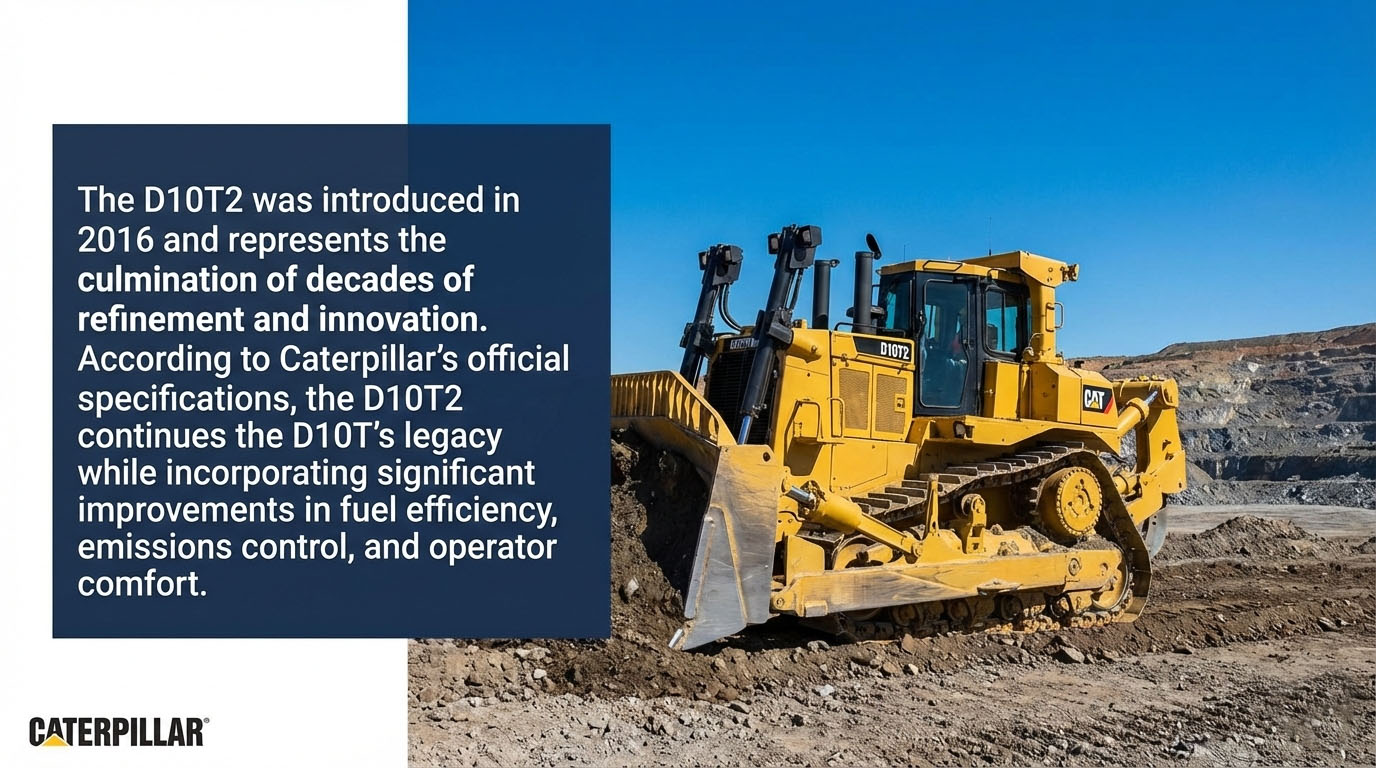
The D10T2 was introduced in 2016 and represents the culmination of decades of refinement and innovation. According to Caterpillar's official specifications, the D10T2 continues the D10T's legacy while incorporating significant improvements in fuel efficiency, emissions control, and operator comfort.
D10T2 Engine and Power
The D10T2 is powered by the Cat C27 ACERT engine with a displacement of 27.0 liters. According to Caterpillar's specifications, the engine delivers net power (SAE J1349/ISO 9249) of 447 kW (600 hp) in forward gears at 1,800 rpm with a torque rise of 21 percent. This represents a significant improvement over the original D10's 700 horsepower rating, but the modern rating standards and increased efficiency mean the D10T2 actually delivers superior performance.
One of the most innovative features of the D10T2 is its power management system. The C27 ACERT engine utilizes the A4E4 Engine Controller, which automatically switches engine power settings based on direction of travel. In reverse, the D10T2 delivers 538 kW (722 hp), approximately 20 percent more power than in forward gears. This increased reverse power enables faster return for reduced cycle times, increasing productivity and lowering the cost per unit of material moved.
Emissions Technology
The D10T2 is offered with two variations of the C27 engine with ACERT Technology. According to Caterpillar's documentation, one version meets Tier 4 Final emission standards and is required for sale in higher regulated countries. The other option is capable of achieving levels equivalent to Tier 2 and Stage II emission standards for lesser or non-regulated countries.
The Tier 4 Final version meets emission standards using the Cat NOx Reduction System, which captures and cools a small quantity of exhaust gas, then routes it into the combustion chamber where it drives down combustion temperatures and reduces NOx emissions. The system also incorporates a Diesel Oxidation Catalyst (DOC) that uses oxidation to condition exhaust gases. The MEUI-C Fuel System delivers increased fuel efficiency while further reducing NOx emissions.
Weight and Dimensions Comparison
The D10T2's operating weight is 70,171 kg (154,700 pounds) according to Caterpillar specifications. This operating weight includes coolant, lubricants, full fuel tank, ROPS, FOPS cab, SU ABR bulldozer, dual tilt, single-shank ripper with pin-puller, fast fuel, 610 mm (24 inch) ES shoes, and operator. The shipping weight is 49,793 kg (109,775 pounds).
Compared to the original D10's weight of 180,000 to 190,000 pounds, the D10T2 appears lighter, but this is because the original D10 was replaced by the larger D11 series. The current D10T2 is sized between the D9 and D11 models in Caterpillar's lineup.
The D10T2 has a transport length of 5.32 meters without blade, a transport width of 3.74 meters, and a transport height of 4.36 meters. With the 10SU ABR blade, the overall length extends to 7,416 mm (292.0 inches), while the 10U ABR blade configuration extends to 7,750 mm (305.1 inches).
Transmission and Drivetrain
The D10T2 features a three-speed planetary powershift transmission with three speeds forward and three speeds reverse. The transmission utilizes large diameter, high-capacity, oil-cooled clutches. According to Caterpillar, the modulation system permits smooth speed and direction changes with the Advanced Productivity Electronic Control System (APECS).
The transmission speeds are: First forward at 4.0 km/h (2.5 mph), second forward at 7.2 km/h (4.5 mph), and third forward at 12.7 km/h (7.9 mph). In reverse: first at 5.2 km/h (3.2 mph), second at 9.0 km/h (5.6 mph), and third at 15.8 km/h (9.8 mph).
The D10T2 maintains the single stage torque converter with output torque divider design, sending 75 percent of engine torque through the converter and 25 percent through a direct drive shaft for greater driveline efficiency, higher torque multiplication, and ease of operation. This is a refined version of the barrel-type planetary powershift transmission used in the original D10.
Advanced Productivity Electronic Control System
APECS is a key contributor to improved speed shift performance in the D10T2. According to Caterpillar documentation, operators will notice enhanced comfort during speed shifting, resulting in an increased level of operator productivity. The improved shift quality provided by APECS enables full benefits of Enhanced Autoshift (EAS).
Enhanced Autoshift is a standard feature for the D10T2. EAS improves fuel efficiency and productivity by automatically selecting the optimal gear and engine speed combination based upon power train load and desired ground speed. This feature functions similarly to an automatic transmission. The system also includes bi-directional shift capability, which allows the operator to automatically select the desired forward and reverse gears by just making a directional change.
Hydraulic Systems Advancement
The D10T2 features field-proven load-sensing implement hydraulics that respond to operating requirements by automatically and continually adjusting implement hydraulic power. According to Caterpillar, tractor performance is improved because hydraulic flow is provided only when implement commands are made, leaving more horsepower available at the tracks to move the machine ahead.
The combined pump output for implements is 380 L/min (100.4 gal/min) measured at 1,800 rpm engine speed. The system uses variable displacement piston pumps. Twin implement pumps matched with newly designed valves offer simultaneous dozer commands such as tilt, pitch, and lift, as well as simultaneous ripper commands like lift and pitch.
The bulldozer relief valve is set at 28,000 kPa (4,061 psi), while the tilt cylinder relief valve is set at 20,300 kPa (2,944 psi). Both ripper lift and pitch relief valves are set at 28,000 kPa (4,061 psi). The complete system consists of pump, tank with filter, oil cooler, valves, lines, and electro-hydraulic pilot valves that assist operations of ripper and dozer controls.
Cooling System Technology
The D10T2 provides durable, efficient cooling for demanding conditions. The cooling system uses a two-part radiator built with rugged, highly effi cient aluminum bar plate cores with 6 fins per inch. According to Caterpillar, the aluminum bar plate construction aids durability and allows for higher heat transfer and superior corrosion resistance.
The system includes a hydraulic oil to air cooler that helps extend component life by reducing hydraulic oil temperatures. A hydraulically variable demand fan operates to match ambient conditions. In cooler environments, the fan turns at a slower speed, consuming only the power required to cool the tractor systems and providing more power to the tracks.
The D10T2 also features air-to-air aftercooling, which cools hot, compressed air coming out of the turbocharger, providing cooler and denser air into the air intake system. This increases power generation, lowers emissions, and improves fuel efficiency.
Undercarriage Design
The D10T2 maintains the elevated sprocket and suspended undercarriage design that made the original D10 revolutionary. The elevated sprocket design transfers implement shock loads to the mainframe, isolating final drives, axles, and steering components from harsh impacts.
According to Caterpillar specifications, the bogie suspension allows the track to conform to ground conditions, providing up to 15 percent more ground contact, especially in hard, uneven terrain. The track gauge is 2,550 mm (100.4 inches), and the length of track on ground is 3,880 mm (152.8 inches).
The redesigned roller frames consist of three main castings to resist bending and twisting. According to Caterpillar, the roller frame improvements include larger rear major bogie pivot pins, redesigned carrier roller mounting pads, and improved major bogie mounting locations. The standard configuration includes eight track rollers per side with the option to add one carrier roller per side.
Mainframe Construction
The D10T2 mainframes are built to absorb high impact shock loads and twisting forces encountered during severe dozing and ripping applications. According to Caterpillar documentation, the main case, equalizer bar saddle, and front cross member are heavy duty steel castings incorporated into highly loaded areas of the mainframe to improve stress distribution for improved durability.
Top and bottom rails are made from continuous rolled sections, providing superior mainframe durability. The main case elevates the final drives well above the ground level work area to protect them from impact loads, abrasion, and contaminants. The pivot shaft and pinned equalizer bar maintain track roller frame alignment and allow the roller frame to oscillate for a smoother ride.
Work Tools and Attachments
The D10T2 offers two primary blade options according to Caterpillar specifications. The 10SU ABR (Semi-Universal Abrasion Resistant) blade has a capacity of 18.5 cubic meters (24.2 cubic yards) SAE J1265. It measures 4,940 mm (194.5 inches) in width with blade over end bits and 2,120 mm (83.5 inches) in height. The blade weighs 11,069 kg (24,403 pounds) and provides maximum digging depth of 674 mm (26.5 inches).
The 10U ABR (Universal Abrasion Resistant) blade offers greater capacity at 22.0 cubic meters (28.7 cubic yards) SAE J1265. It is wider at 5,260 mm (207.1 inches) with blade over end bits, maintaining the same 2,120 mm height. The U blade weighs 12,413 kg (27,366 pounds).
Both blades feature dual tilt capability, allowing the operator to optimize blade pitch angle. Cutting edges are made of DH-2 steel, while end bits are made of DH-3 steel for maximum service life in tough materials.
Ripper Capabilities
The D10T2 offers both single-shank and multi-shank ripper options. The single-shank ripper with standard tooth provides maximum penetration force (shank vertical) of 219 kN (49,233 lbf) and maximum penetration of 1,504 mm (59.2 inches) with standard tip. The single-shank deep ripper provides 236 kN (53,055 lbf) penetration force and 1,988 mm (78.3 inches) maximum penetration.
The multi-shank ripper with standard tooth has an overall beam width of 2,920 mm (115 inches) and provides maximum penetration force of 208 kN (46,760 lbf) with maximum penetration of 950 mm (37.4 inches). The ripper features the CapSure Hammerless Ripper Tip and Shank Protector Retention System, which allows the tip and shank protector to be installed with a 180-degree turn of a three-quarter inch ratchet, eliminating hammering and improving safety.
Operator Station Improvements
The D10T2's cab design provides ergonomic controls, intuitive monitoring systems, and enhanced visibility. According to Caterpillar, standard machines provide 77 dB(A) operator noise levels, with lower sound levels available if optional sound suppression packages are installed. When all three sound suppression options are ordered (sealed bottom guards, solid engine compartment enclosures with insulation, and sound reducing idlers and machined sprocket segments), the package can deliver a 4 dB(A) reduction in average spectator sound power level and a 3 dB(A) reduction in average operator sound pressure level.
The Cat Optimized Seat has six-way adjustment control for optimal support and comfort. Seat side bolsters restrain side-to-side movement, especially when working on side slopes. The automatic climate control system automatically adjusts heating and air conditioning controls to maintain a consistent cab temperature throughout the day.
The information display is a multi-color touch screen located at the front of the right hand console. According to Caterpillar, this display is the operator's gateway to monitoring machine performance and provides a convenient way of modifying machine parameters to tailor performance to the current task. The Work Monitor menu screen collects machine data and provides real-time feedback on machine performance to optimize productivity.
Integrated Technologies
The D10T2 electronic systems have been completely integrated to function as one machine. According to Caterpillar, this integration creates a smart machine and more informed operator, maximizing the productivity of both.
VIMS 3G gathers historical trends, histograms, events, and more through a wired connection for off-board analysis. Product Link enables remote transmission of information about the location, operation, and condition of equipment, allowing efficient monitoring of fleet performance to help keep jobs on schedule and maintain equipment condition.
Automated Blade Assist (ABA) is standard on the D10T2 when equipped with optional dual tilt. According to Caterpillar, ABA increases efficiency while reducing operator workload by making use of preset blade pitch positions.
AutoCarry is an optional feature that provides automatic blade control during the carry segment of the dozing cycle by measuring ground speed and track slip with a robust Global Navigation Satellite System (GNSS) chassis-mounted receiver. Blade position is changed automatically to keep slip at optimum level for best performance. It is intended to enhance operator productivity in high production earthmoving applications with carry distances over 30.5 meters (100 feet).
Fuel Efficiency Improvements
According to Caterpillar's sustainability documentation, the D10T2 with a C27 ACERT engine meeting Tier 4 Final emission standards provides up to 2 percent better fuel efficiency over a D10T performing the same composite work cycle. The D10T2 with a C27 ACERT engine capable of achieving emission levels equivalent to Tier 2 and Stage II emission standards provides up to 10 percent better fuel efficiency over a D10T performing the same composite work cycle.
Safety Features
The D10T2 incorporates numerous safety features. The seat belt warning system reminds the operator to engage the seat belt anytime the key is on. If the operator does not engage the seat belt and places the machine in gear, a chirping sound is initiated.
The Operator Not Present Monitoring System locks out the power train and hydraulics under certain conditions to prevent unintentional movement when the operator is not in the seat. Heavy duty steps and handles are strategically placed, with non-slip steps and decking to aid operators getting on and off the machine.
The D10T2 offers fourteen total anchorage points: four on lift cylinder spray shields, four on the top surface of the hood, two on the front top of the cab, and four on the ROPS structure. These anchorage points provide personnel with a positioning system to perform repairs and maintenance safely.
The ROPS meets ISO 3471:2008 criteria, while the FOPS meets ISO 3449:2005 LEVEL II criteria according to Caterpillar specifications.
Serviceability Enhancements
According to Caterpillar, a key advantage of the D10T2's modular design is the ability to swap out a component with a pre-tested rebuilt or remanufactured unit that puts the machine back to work faster.
The ground level service center mounted on the ripper cylinder or counterweight provides easy access to the access lighting switch, engine shutdown switch, and hydraulic ladder controls. The high speed oil change system is standard in the engine compartment and allows control of fluids while increasing the speed of oil changes for both the engine and power train.
The Ok-to-Start strategy provides electronic fluid level verification at startup on the engine coolant, engine oil, and power train oil systems. All information is available via the information display within the cab. The fast fuel system at ground level, with positive fuel shut-off to prevent fuel spillage, can reduce fuel waste and decrease downtime.
Service Refill Capacities
According to Caterpillar specifications, the D10T2 has the following service refill capacities: fuel tank at 1,190 liters (314.4 gallons), cooling system at 180 liters (47.6 gallons), engine crankcase with oil filters at 68 liters (18 gallons), power train at 230 liters (60.8 gallons), each final drive at 23 liters (6.1 gallons), each roller frame at 64 liters (16.9 gallons), pivot shaft compartment at 33 liters (8.7 gallons), and hydraulic tank at 131 liters (34.6 gallons).
Cat Mine Star Integration
The D10T2 comes out of the factory ready to integrate Cat Mine Star technology. According to Caterpillar, Mine Star helps manage everything from material tracking to sophisticated real-time fleet management, machine health systems, autonomous equipment systems, and more.
MineStar Fleet provides mines a comprehensive overview of all operations with real-time machine tracking, assignment, and productivity management. Mine Star Terrain for Grading is a machine guidance system that delivers real-time productivity information to operators. The system features an in-cab display, satellite navigation technology, machine-mounted components, and fully integrated office software.
MineStar Command for Dozing removes the operator from the cab and enables remote control operation, either through an over-the-shoulder operator console for line-of-sight operation or through a comfortable remote operator station for both line-of-sight and non-line-of-sight remote control.
Comparing Generations
When comparing the D10T2 to the original D10, the advances become clear. While the original D10 delivered groundbreaking power at 700 horsepower, the D10T2 delivers 600 horsepower in forward gears and 722 horsepower in reverse through a more efficient engine that meets modern emission standards while consuming less fuel.
The original D10's planetary powershift transmission has evolved into the D10T2's electronically controlled powershift transmission with APECS, providing smoother shifts and automatic gear selection. The simple hydraulic systems of the original have been replaced with sophisticated load-sensing hydraulics that deliver power only when needed, improving fuel efficiency.
The elevated sprocket design pioneered by the original D10 has been refined over four decades in the D10T2, with improved roller frames, better bogie suspension, and enhanced durability. The operator station has evolved from a basic ROPS cab to a sophisticated ergonomic environment with multi-color touch screens, automatic climate control, and advanced monitoring systems.
Conclusion
The Caterpillar D10T2 represents the culmination of nearly 50 years of continuous refinement and innovation. From the revolutionary High Drive system introduced in the original 1977 D10 to the sophisticated electronic controls and emission systems of the D10T2, each generation has built upon the strengths of its predecessor while addressing the evolving needs of the mining and construction industries.
According to Caterpillar's documentation, the D10T2 offers superior fuel efficiency, lower emissions, enhanced operator comfort, and improved productivity compared to earlier models. The integration of advanced technologies like APECS, Enhanced Autoshift, load-sensing hydraulics, and MineStar compatibility makes the D10T2 not just a powerful dozer, but a smart machine capable of delivering maximum productivity at the lowest cost per unit of material moved.
The D10 series has proven itself over decades as a highly productive and versatile machine, flexible enough for heavy construction sites and robust enough for mine sites. As Caterpillar states in their documentation, customers can count on the D10T2's superior performance, long life, ease of operation, and world-class service from the global Cat dealer network to be the backbone of their operation, continuing the legacy that began with the revolutionary D10 in 1977.